


Today marks an exciting milestone: we’re officially launching SimPatient.co.uk. At the same time, OpenAI for Education are featuring our work in their educator Academy — a recognition of how generative AI can meaningfully transform medical education.
Why SimPatient?

Medical schools everywhere face the same challenge: student numbers are increasing, but placement opportunities and teaching capacity are not. Communication skills training — vital for safe, patient-centered care — has traditionally relied on actor-patients. But actors are expensive, hard to scale, and can only deliver a handful of encounters at a time.
SimPatient provides a solution. It gives students unlimited access to realistic, AI-powered patients who can be consulted by voice, video, or text. Each interaction is unique, lifelike, and followed by structured feedback aligned with established communication frameworks.
What Makes It Different
SimPatient is not just another chatbot. It combines:
A proprietary clinical language model fine-tuned on real consultations.
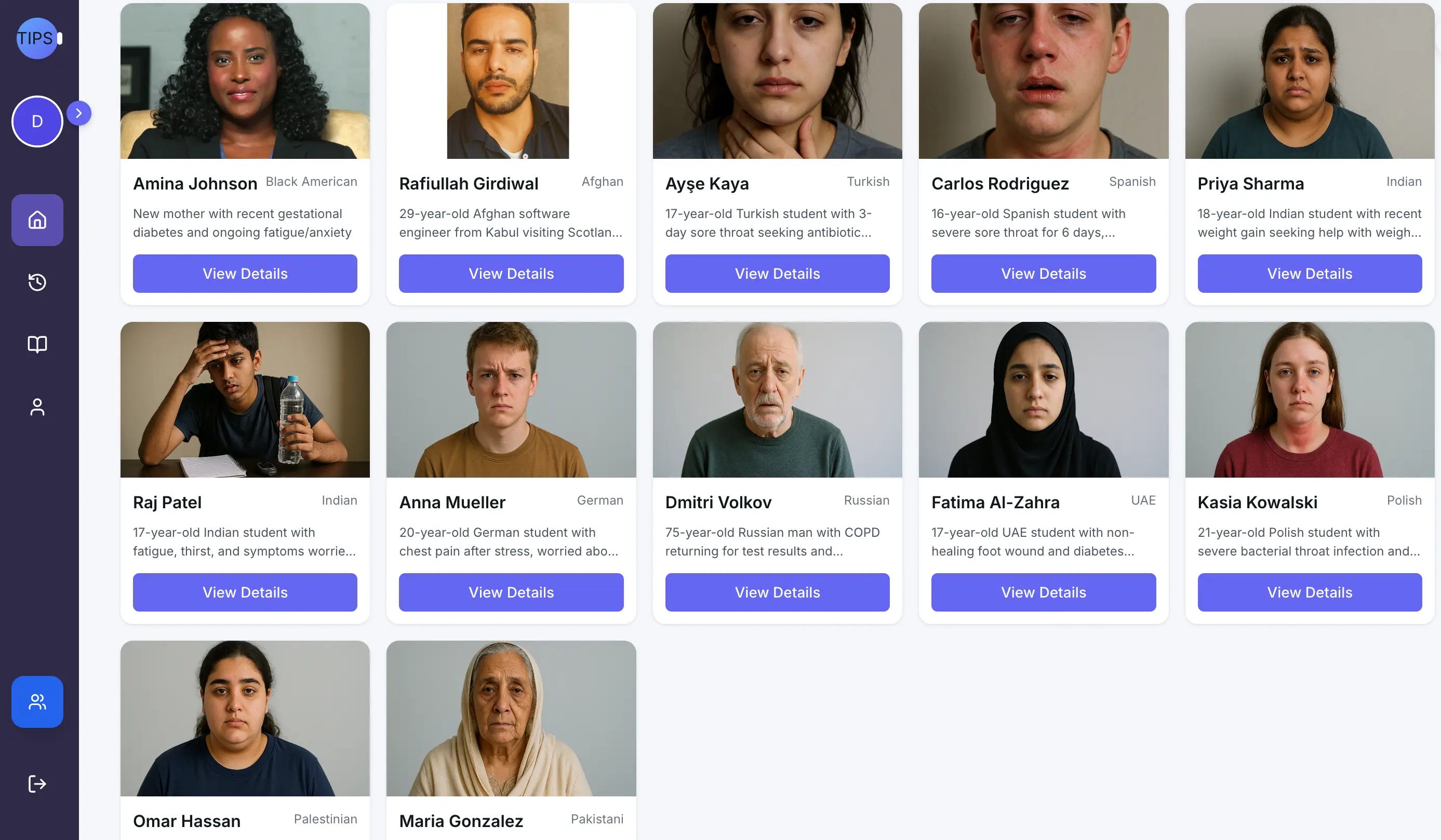
Photorealistic avatars with natural speech and expression.
A diversity engine to ensure representation across age, ethnicity, accent, and socioeconomic background.
Educator tools for authoring and adapting cases to local curricula.
This makes it possible to rehearse the full complexity of clinical communication (including empathy, nuance, and cultural competence) at scale.
Where We’re Starting
Our first rollout is with ~700 students at the University of St Andrews. Over the next year, we’ll expand to 50 cases covering community, rural, and telehealth contexts. We’re also building VR and audio-only modes, so learners can practice anywhere — from high-fidelity labs to low-bandwidth rural settings.
At the same time, we’re speaking with universities, ed-tech companies, and publishers about embedding SimPatient into existing platforms and curricula.
Why It Matters
This launch is about more than just one product. It’s about preparing the next generation of clinicians for the realities of practice: diverse patients, complex consultations, and the growing importance of telehealth. With SimPatient, we can scale experiential learning in a way that meets both the educational and workforce challenges ahead.
We’re proud to share SimPatient with the medical education community, and we’d love for you to explore it at SimPatient.co.uk, and on LinkedIn and X.


